
CLSA managing director & equity strategist Christopher Wood, and executive director Mahesh Nandurkar tell Puneet Wadhwa that the markets could give a return of around 10 per cent from the current level over the next year.

It has raised rural consumption, created new markets and shored up growth when investment falters.

The National Council of Applied Economic Research (NCAER) on Thursday lowered the GDP projection for the current fiscal to 4.7-4.9 per cent due to exchange rate depreciation.

The overall message to the middle class is: the days of freebies are over.

'They should decide their allocation based on their risk appetite and age, and not valuations.'

While naysayers say the economy is on a downward spiral, optimists point out that India has experienced a shift of gears in the realm of policies, thanks to several initiatives of the Narendra Modi government, says Ashok K Lahiri.
India Inc has an impressive report card to show for the first quarter of this financial year.

As West Bengal, Kerala, Assam, Tamil Nadu and Puducherry prepare for new administrations, one is reminded of the disparity that runs through the veins of the Indian states, notes Mihir S Sharma.

Depreciating the rupee against the dollar to boost economic growth has fiscal constraints and monetary limitations

Excise exemptions may be whittled in Budget to offset higher govt salaries, pensions

China will increase its defence spending by "around seven per cent" this year, as it vowed to guard against "outside meddling" in its territorial disputes.

From February to mid-March, oil prices receded rapidly.

'We think FY18 will end with a 10 to 12 per cent earnings growth, but FY19 will see a recovery to over 15 per cent.'


Along with the US and China, India could be a big enough force in global manufacturing

Excerpts from a speech on the Supplementary Demands for Grants, December 15.
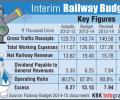
Anticipating healthier economic growth, the Railways has targeted a record Rs 1.6 lakh crore in revenue for the next financial year, while no increase has been proposed in passenger fares and freight rates.
Jaitley said growing at 8-10 per cent for a significant number of years will help India find an answer to poverty.

The Budget for 2018-19 has at least five takeaways that are yet to receive adequate attention, says A K Bhattacharya.

To do so, the government will have to tackle a number of broad development challenges successfully, says Shankar Acharya

For India, it is business as usual with the government muddling along.

Technically speaking, US equities have seen net losses since January. India is strongly influenced by US trends.

The Election Commission will for the first time keep a watch on the spending on social media by the political parties in the upcoming Lok Sabha elections.

Invest 5 to 10 per cent in a banking sector fund. Ensure that mutual fund's portfolio includes all three players -- private sector banks, public sector banks and NBFCs.

RBI will now increasingly shift focus to domestic parameters

'We believe 2017 could see higher flows from foreign institutions as money comes back to growth markets like India.'

'While GST and demonetisation are likely to cause disruption for longer than the market currently expects, they can have meaningful positive impact over the medium-term.'

'The domestic scenario is much better than earlier, demonstrated in the March quarter earnings.'
The coming elections seem a tough battleground for the BJP in the wake of anti-incumbency, Patidar and Dalit agitations and implementation of the GST.

There are chances of taps running dry and prices of fruits and vegetables spiking.

Indian indices have hit all-time highs in the New Year and the sentiment remains strong. All valuations are also at extremely high levels, cautions Devangshu Datta

The sops sanctioned by J Jayalalithaa on her first day in office could cost the exchequer up to Rs 8,000 crore annually.

A road map could be laid out for a gradual reduction in the tax rates from the current incidence of about 62-94 per cent without causing a major blow to the revenues of the Centre and the states. The opportunity arising out of higher GST collections should not be squandered, says A K Bhattacharya.

Being mandatory, these recommendations will have to be immediately built into the Budget for 2015-16.

These institutes, while expensive, are a viable alternative to studying abroad.

Bank of America Merrill Lynch believes this would ease pressures on CAD as $10 a bbl fall in oil price reduces CAD by $8 billion or 0.4 per cent of GDP.

India's list of non-cricket sports stars is growing, but when it comes to endorsement deals, the bulk of the money is spent on a handful of cricketers.

Low consumer demand, a slide in investments and troubles in the banking sector should prompt the government to recalibrate taxes and expenditure. It is also important to ramp up spending on health care and education, says CII president Sumit Mazumder.

Industrialists affirm their belief that the adverse effects of demonetisation and the goods and services tax are finally over.

While demonetisation will benefit the organised sector, the government has to find a way to channel the upcoming revenue buoyancy towards job creation to balance out job losses in the informal sector, says Akash Prakash.
